
Mediation helps separating or separated parties resolve parenting and property disputes through a structured, confidential, and professionally facilitated process. It allows parties to reach practical, sustainable agreements without the need for contested Court proceedings.
Family Dispute Resolution (FDR) is a specialised form of mediation required in most parenting matters before applying to the Court. Our Registered Family Dispute Resolution Practitioners (FDRPs) facilitate parenting and property mediation and can issue a Section 60I Certificate where required.
Our team also includes an Australian Mediator and Dispute Resolution Accreditation Standards mediator (AMDRAS-accredited mediator) with particular expertise in complex property disputes involving businesses, trusts, and multi-asset financial arrangements.
Mediation allows you to reach agreement about post-separation parenting arrangements and property division in a structured and supported environment. In many cases, particularly where parenting matters are in dispute, parties are required to attempt Family Dispute Resolution before applying to the Court.
-
Reduced stress and emotional burden, by avoiding a potentially lengthy and adversarial Court process;
-
Greater control over outcomes, rather than having decisions imposed by the Court;
-
Earlier resolution, without waiting for Court availability and delays;
-
Stable and workable co-parenting arrangements, supporting longer-term family functioning;
-
Reduced legal costs, compared with contested Court proceedings; and
-
Flexible and future-focused agreements, allowing parenting and financial arrangements to evolve as circumstances change.
Not sure where to start?
Select the option that best fits your situation
START FAMILY DISPUTE RESOLUTION
If you are looking to resolve parenting or property matters following separation, Family Dispute Resolution (FDR) provides a structured process to help reach agreements without going to Court.
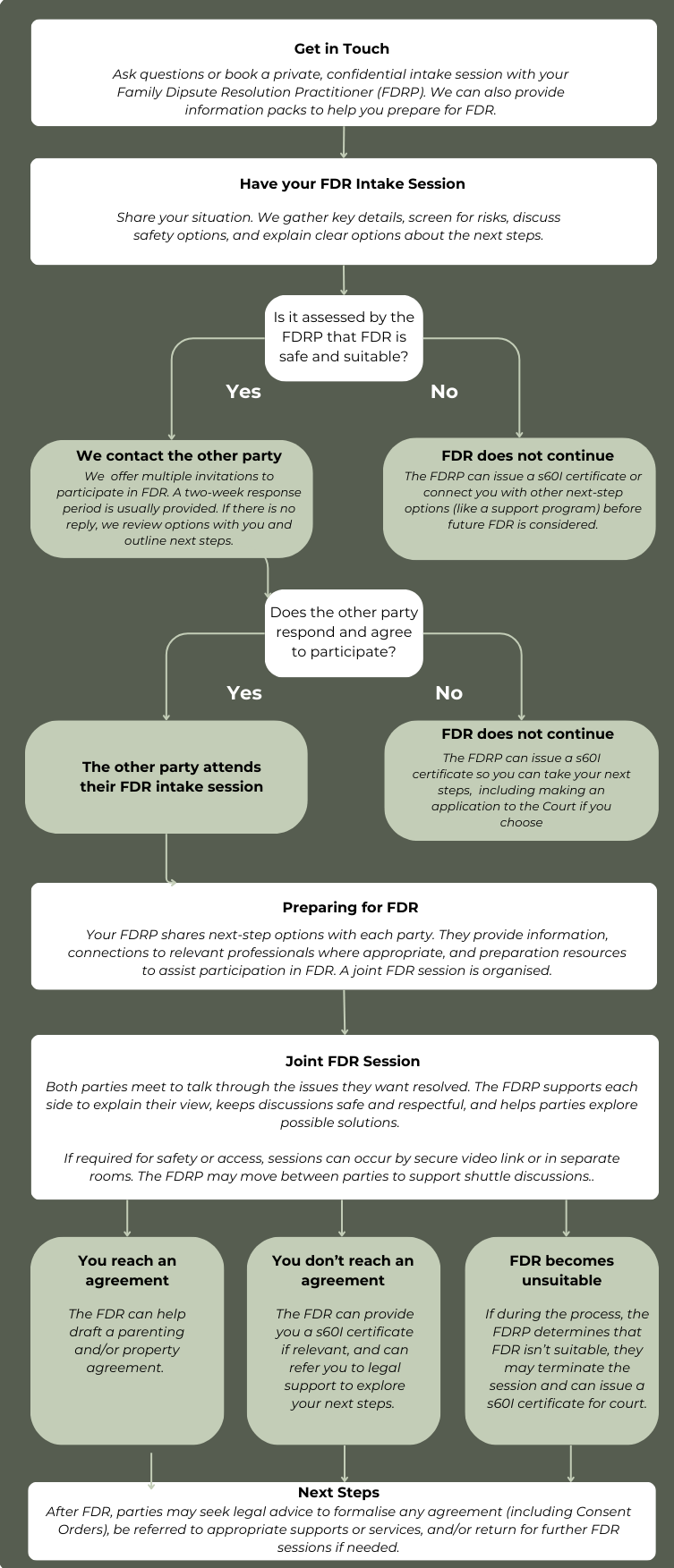
All matters begin with an individual intake appointment, where we:
understand your circumstances
assess whether FDR is appropriate and safe
explain the process and answer your questions
If suitable, the other party will be invited to participate.
Your Options
Parenting And/Or Property
Parenting and/or Property FDR focuses on helping separating or separated parties reach agreements regarding parenting arrangements for their children, the division of property, or both, in a structured and collaborative process.
Child Inclusive FDR
Child-inclusive FDR involves one of our child consultants, Dr Rayleigh Joy or Liz Katona, meeting with the children to understand their perspectives and needs, followed by a feedback session with parents to share insights and support child-focused decision-making.
Single-Issue FDR
Single-issue FDR focuses on resolving a specific, standalone disagreement that arises between parties, such as selecting a school for a child or addressing a particular decision, by providing support to navigate and overcome that specific sticking point.
Gender-Balanced Co-FDR
Male/female gender-balanced co-FDR involves two mediators, one male and one female, working together to provide their perspectives and create a neutral, inclusive environment for resolving disputes.
Cross-Cultural and Culturally Adaptive FDR
Cross-cultural and culturally adaptive FDR involves tailoring the mediation process to respect and integrate the cultural backgrounds, values, and communication styles of all parties, ensuring a culturally sensitive and inclusive approach to resolving disputes.
The FDR Process
Family Dispute Resolution follows a structured pathway designed to ensure safety, fairness, and informed participation at each stage.
COMPLEX PROPERTY & FINANCIAL MATTERS
We also offer mediation services for matters that do not require Family Dispute Resolution (FDR), including complex property and financial disputes.
These mediations are facilitated by Dr Raj Aseervatham, an AMDRAS-accredited mediator, and support the resolution of matters involving businesses, trusts, superannuation, and multi-asset financial structures within a clear and structured negotiation framework.
Mediation may be appropriate where:
the matter relates to complex property or financial settlement
FDR is not required or has already been attempted
parties are seeking a structured, facilitated discussion outside of Court
All matters begin with an intake process to determine suitability and the appropriate pathway.
Why Choose The Groundworks Lab?
Court-level expertise – Our practitioners also work as family report writers, single expert witnesses, and child consultants.
Accredited mediation professionals – Including Registered Family Dispute Resolution Practitioners and an AMDRAS-accredited mediator.
Expertise across parenting and property disputes – From parenting arrangements to complex financial and business matters.
Trusted by families, lawyers, and Courts – We facilitate mediation in legally represented and self-referred matters.
Structured, balanced, and professionally managed process – Supporting clear, practical, and sustainable agreements.
Child-focused and legally informed approach – Grounded in child development and Court-relevant decision-making.
Meet Our Practitioners
Dr Raj Aseervatham
Director
PhD, MBA, GradDipFDRP, MSB, AMDRAS

Liz Katona
Partner
BBehavSc(Psych), LLB(Hons), GradDipLegalPrac, MSW, GradDipFDRP

Liz is an accredited Family Dispute Resolution Practitioner with specialist expertise in child-focused mediation and complex post-separation parenting dynamics. She brings a unique multidisciplinary background in law, psychology, and social work, enabling her to understand not only the legal and procedural requirements of mediation, but the developmental, emotional, and safety impacts on children.
Liz has extensive experience working with families affected by high conflict, power imbalances, trauma histories, and entrenched parenting disputes. Her approach is structured, calm, and child-centred, with a strong focus on safety, accountability, and workable outcomes.
Liz facilitates mediation in both parenting matters and property matters involving straightforward financial arrangements, supporting parties to clarify issues, communicate effectively, and reach practical and sustainable agreements.
Clients often value Liz’s ability to hold difficult conversations while maintaining clarity, fairness, and respect. She supports parents to engage meaningfully in the process, understand the impact of conflict on children, and develop agreements that prioritise children’s wellbeing while remaining realistic and durable over time
INVITED TO FDR?
If you’ve received an invitation to participate in Family Dispute Resolution (FDR), it’s common to feel unsure, confused, or even sceptical.
You have not done anything wrong by being invited. It simply means the other party is seeking to explore whether agreements can be reached outside of Court.
What this means for you:
- You are not required to agree to anything in this process
- You will first have a private intake session with the practitioner
- The practitioner will assess whether FDR is appropriate and safe
- You can obtain legal advice at any stage
- You can choose whether or not to proceed after intake
What this process is (and is not):
- It is a structured, facilitated discussion
- It is not therapy
- It is not a court hearing or decision-making process
- The practitioner is independent and does not take sides
Why you’ve been invited:
In many parenting matters, the Court expects parties to attempt FDR before progressing. This process gives both parties the opportunity to:
- explore possible agreements
- clarify issues
- and potentially avoid the time, cost, and stress of litigation

What happens next:
You may be contacted by our team, or you can contact us directly to discuss the invitation
If you are open to participating, an individual intake appointment will be arranged with a practitioner
This intake is a private and confidential conversation to understand your circumstances, answer questions, and assess whether FDR is appropriate
If the matter is assessed as suitable and both parties are willing, a mediation session may be scheduled
You are not required to reach agreement, and you can seek legal advice at any stage
We understand that starting this process can feel uncertain. Our role is to ensure that you are informed, supported, and able to participate in a way that feels safe and appropriate.
Frequently Asked Questions
-
What are the fees?
Our Family Dispute Resolution services are provided on a private fee-for-service basis. Fees depend on the issues being mediated, whether child-inclusive practice is required, and the number of children involved.
-
What is mediation?
Mediation is a structured process in which an independent and impartial practitioner helps parties resolve disputes through guided discussion and negotiation. Mediation can address parenting arrangements, property division, or both, and focuses on helping parties reach practical, informed, and sustainable agreements without the need for Court determination.
-
What is Family Dispute Resolution (FDR)?
Family Dispute Resolution is a specialised form of mediation conducted by a Registered Family Dispute Resolution Practitioner (FDRP). It is required in most parenting matters before applying to the Court, unless an exemption applies. FDRPs can issue a Section 60I Certificate under the Family Law Act 1975 where appropriate.
-
Do both parties have to agree to FDR?
Yes. FDR is a voluntary process, and both parties must be willing to participate. Either party may pause or discontinue mediation at any time.
-
Is FDR legally binding?
FDR itself does not impose decisions. If agreement is reached, the terms can be formalised into legally binding documents, such as Consent Orders, usually prepared with the assistance of your lawyers.
-
Do I have to attend Family Dispute Resolution before going to Court?
In most parenting matters, the Court requires parties to attempt Family Dispute Resolution before filing an application, unless an exemption applies. An FDRP can issue a Section 60I Certificate confirming that mediation has been attempted or assessed as inappropriate.
Property matters do not require a Section 60I Certificate, but mediation is strongly encouraged to resolve disputes efficiently.
-
Do I need a lawyer to attend FDR?
You are not required to have a lawyer present, but obtaining independent legal advice before and after FDR is strongly recommended. Lawyers may attend FDR if appropriate and agreed by all parties.
-
How does the FDR process begin?
The process usually begins with a private intake session with each party. This allows the mediator to understand the issues, assess suitability, and ensure the process can proceed safely and effectively. If mediation is appropriate and both parties agree, a joint FDR session is then scheduled.
-
How long does FDR take?
-
Is FDR confidential?
Yes. FDR is confidential, except in limited circumstances such as risks to safety or where disclosure is required by law. This allows parties to speak openly and explore resolution options safely.
-
What happens if we cannot reach agreement?
If agreement is not reached, parties may pursue other options, including further negotiation through lawyers or Court proceedings. In parenting matters, an FDRP may issue a Section 60I Certificate where appropriate.
-
How do I find out more?
Please contact our office and a comprehensive pack including options for FDR structure and cost will be sent to you via email.
Take the First Step Toward Resolution
The first step is a private intake appointment to understand your circumstances and determine the most appropriate mediation pathway.
Intake appointments are conducted privately and without obligation to proceed to mediation.